5. Manuscript evidence
What can manuscripts tell us about the cult of saints in the early Middle Ages in general and the cult of Radegund particularly?
Let us take one example from the 9th or 10th centuries, most likely not produced in the German-speaking world (i.e. not St Gallen scriptorium): St. Gallen, Stiftsbibliothek, Cod. Sang. 561.
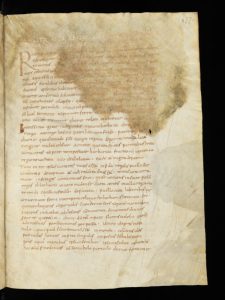
The manuscript is in 3 codicological units that were combined later. The first codicological unit contains a number of saints' lives:
- 3-20 Passio apostolorum Petri et Pauli
- 20-27 Passio Andreae apostoli
- 27-28 Passio Iacobi [minoris] apostoli fratris domini
- 28-30 Passio Philippi apostoli
- 30-37 Passio Iacobi [maioris] apostoli fratris Iohannis
- 37-52 Passio Thomae apostoli
- 52-59 Passio Bartholomei apostoli
- 60-70 Passio lohannis apostoli
- 70-82 Passio Mathei apostoli
- 82-93 Passio Symonis [chananei] et Iude zelotis apostolorum
- 94 empty
- 95-111 [Cassiodorus: Excerpta Historiae tripartitae]
- 111-134 [Ps.-Amphilochius: ] [Vita, miracula et exempla] sancti Basilii [cum relationibus sanctorum patrum]
- 134-137 Reversio [i. e. Exaltatio] sanctae crucis
- 137-139 Passio sanctae Eulaliae martyris
- 139-152 Vita sanctae Genovevae
- 152-162 Passio sancti Eustachii martyris
- 162-166 Passio sanctae Agnetis virginis
- 166-169 Passio sanctae Luciae [recte: Luceiae] virginis
- 169-174 Passio sanctae Agathae virginis
- 174-176 Passio sanctae Columbae virginis
- 177-184 [Venantius Fortunatus:] Vita beatae Radegundis
The life of Radegund by Venantius Fortunatus is included at the end. What does this tell us?
The list of apostles, martyrs, and saints (with the addition of a history) is largely chronological. It is possible that the Vita Radegundis, or Life of Radegund, formed a larger attempt at combining history writing.
Let's look at another example, Zürich, Zentralbibliothek, Ms. C 10i, from the same period, possibly from Reichenau:
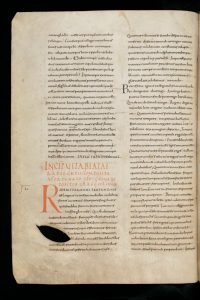
This is another composite manuscript with a number of saints' lives. However, this manuscript does not organise by chronology of when the saints lived and died:
- [...]
- fol. 157'-159' passio s. ac beatissimi laurentii m. siue archidiaconi quod est IV id aug
- fol. 159'-161 >uita s. ac beatissimi gaugerici ep. et cf. cuius depositio III id aug
- fol. 161-162' >passio s. yppoliti m. quod est id aug.
- fol. 162'-166' >uita b. radegundis composita a fortunato ep. cuius depositio id aug.
- fol. 166'-169 >passio ss.. mm. isaac et maximiani quod est octavo die kl sep.
- fol. 169-170 >passio ss. mm. timothei et apollenaris quod est X kl sep.
- [...]
Here, the manuscript is organised by liturgy and feast day. The Life of Radegund, whose feast day for her burial is the ides of August, follows the Passion of St Hyppolitus, whose feast day is also the ides of August, and precedes the Passion of Isaac and Maximianus, whose feast day is the Kalends of September.
Significantly, the whole text is not transmitted in the manuscript.