4. New Philology
Manuscript Evidence: The Problem
Saints’ lives often include interesting, funny, or surprising stories.
Yet the manuscript evidence for medieval saints’ lives often provide a complex picture. There is commonly a gap of several centuries between the time that the saints’ life was composed and the first extant manuscript witnesses — this is excluding the issue of the historical figures of saints, which also often depicted individuals who are thought to have lived several centuries before.
How should historians and philologists work with hagiography?
"New Philology"
The term "New Philology" refers to a more material-focused approach to the study of texts, rather than attempting to reconstruct originals, or an "Urtext". Sometimes it is called "Material Philology".
Work, Text, Artefact
In the context of complex manuscript evidence, it is useful to distinguish between ‘the “work”, the “text” and the “artefact”, following developments from New Philology. Consider the distinction made by Driscoll:
“To take a simple example: Hamlet is a “work”. The New Swan Shakespeare Advanced Series edition of Hamlet by Bernard Lott, M.A. Ph.D., published by Longman in 1968, is, or presents, a “text”. My copy of Lott’s edition, bought from Blackwell’s in Oxford in 1979 and containing my copious annotations, is an “artefact”
(Driscoll 2010: https://www.driscoll.dk/docs/words.html)
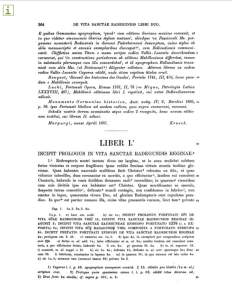
To provide a different example, this is an edition of the Life of Radegund, based on a number of manuscripts and published by the Monumenta Germaniae Historica:
This is a manuscript copy of the Life of Radegund:
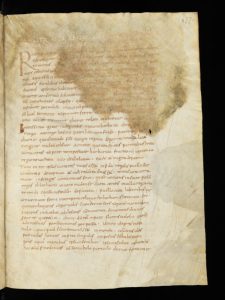
The original, unfortunately, is lost.
What can the surviving sources tell us about Radegund and her cult? About hagiography in the time of the author, Venantius Fortunatus? And equally saints and hagiography at the time of the manuscripts that do survive? On which level can we and should we study hagiography as historians?